Showing posts with label organic gardening. Show all posts

Thursday, November 10, 2011

When & How to Prune Fruit Trees

UPDATED- January 3, 2012 
I am re-posting this useful information now because this is an optimal time to prune fruit trees in most North American regions.

     Some of you may be aware that I have been going to school for some time, studying plant biology and crop science.  I am not going to try to reinvent the wheel, but I want to share some important information that's available for free to all of us from the University of California (UC) Cooperative Extension, California Backyard Orchard website page about pruning and training fruit trees. (Link below)  It's very helpful for backyard orchards even if you only have one fruit tree.  California's unique topography includes almost every USDA hardiness zone, so knowing yours, you can glean exactly what you need from the site, no matter what state you're in.
     A good friend recently asked me when she should prune her fruit trees.  Not now, I cautioned, it's too soon.  January is the best time to prune most fruit trees according to the University of California Master Gardener Program.  We must wait until the trees have pulled the nutrients from leaves, branches, and stems into the roots for winter and are dormant. (December to February for most regions).   Follow the link below to learn everything you need to know to prune and shape your fruit trees for optimal harvests.
    The excerpt below is a great example of just how practical UC website information is, and it's just a small snippet taken from the Backyard Orchard Pruning & Training page linked above:

Ten Basics of When and How to Prune Fruit Trees
Prune fruit trees when the leaves are off (dormant). It’s easier to see what you are doing and removal of dormant buds (growing points) invigorates the remaining buds. Summer pruning removes leaves (food manufacture), will slow fruit ripening, and exposes fruit to sunburn. Summer pruning can be beneficial, however, when used to slow down overly vigorous trees or trees that are too large. It is usually done just after harvest. 

Right after planting a new tree, cut if off to short stick 24 to 30 inches high and cut any side shoots, remaining below that, to one bud. This encourages low branching and equalizes the top and root system. Paint the tree with white latex paint to protect it from sunburn and borer attack. 

Young trees should be pruned fairly heavily and encouraged to grow rapidly for the first 3 years without any fruit. Leave most of the small horizontal branches untouched for later fruiting. 

When deciding which branch to cut and where to cut it, remember that topping a vertical branch encourages vegetative growth necessary for development of the tree and opens the tree to more sunlight. Topping horizontal branches is done to renew fruiting wood and to thin off excessive fruit. Horizontal branches left uncut will bear earlier and heavier crops. 

Upright branches generally remain vegetative and vigorous. Horizontal branches generally are more fruitful. A good combination of the two is necessary, for fruiting now and in future years. Remove suckers, water sprouts and most competing branches growing straight up into the tree. Downward bending branches eventually lose vigor and produce only a few small fruit; cut off the part hanging down. 

New growth occurs right where you make the cut; that is the influence of the cut only affects the buds within 1 to 8 inches of the cut surface not 3 to 4 feet down into the tree. The more buds cut off the more vigorous the new shoots will be. 

Do most of the pruning in the top of the tree so that the lower branches are exposed to sunlight. Sun exposed wood remains fruitful and produces the largest fruit. Shaded branches eventually stop fruiting and will never produce without drastic topping and renewal of the entire tree. 

Make clean cuts (within ¼") of bud; don’t leave stubs. 

Use spreaders or tie downs to get 45° angles branches of upright vigorous growing trees. 

Peach and Nectarine remove 50% of last years growth. Fig, Apple, Pear, Plum and Apricot remove about 20% of last years growth. Cherries only summer prune the first 5 years.

Agriculture & Natural Resources, University of California. http://homeorchard.ucdavis.edu/The_Big_Picture/Pruning_&_Training/. November 10 2011.

The UC web system is huge and full of great, crop specific production information for both the home gardener and the commercial grower. Another wonderful UC resource for fruit and nut tree growers is the UC Fruit & Nut Research and Information Center website:

http://fruitsandnuts.ucdavis.edu/

I hope your fruit trees grow well and produce a bounty.

Saturday, October 1, 2011

FARM LAB FRIDAY Integrate Pest Management in Vegetable Crop Production Class

Well, another busy, exciting week is winding down and I have so much to share.


I took a mid-term at school followed by an introduction to Hydroponics at the school greenhouse.  Believe it or not, these romaine lettuce transplants are the same age as these in the field...  


Hydroponics create perfect growing conditions for plants: climate control, mineral and nutrient control, and pest control.  Both plants came from the same batch of transplants we planted a few weeks ago, and the field romaine looks great, but the hydroponically grown romaine is almost 300% as big.  Amazing.


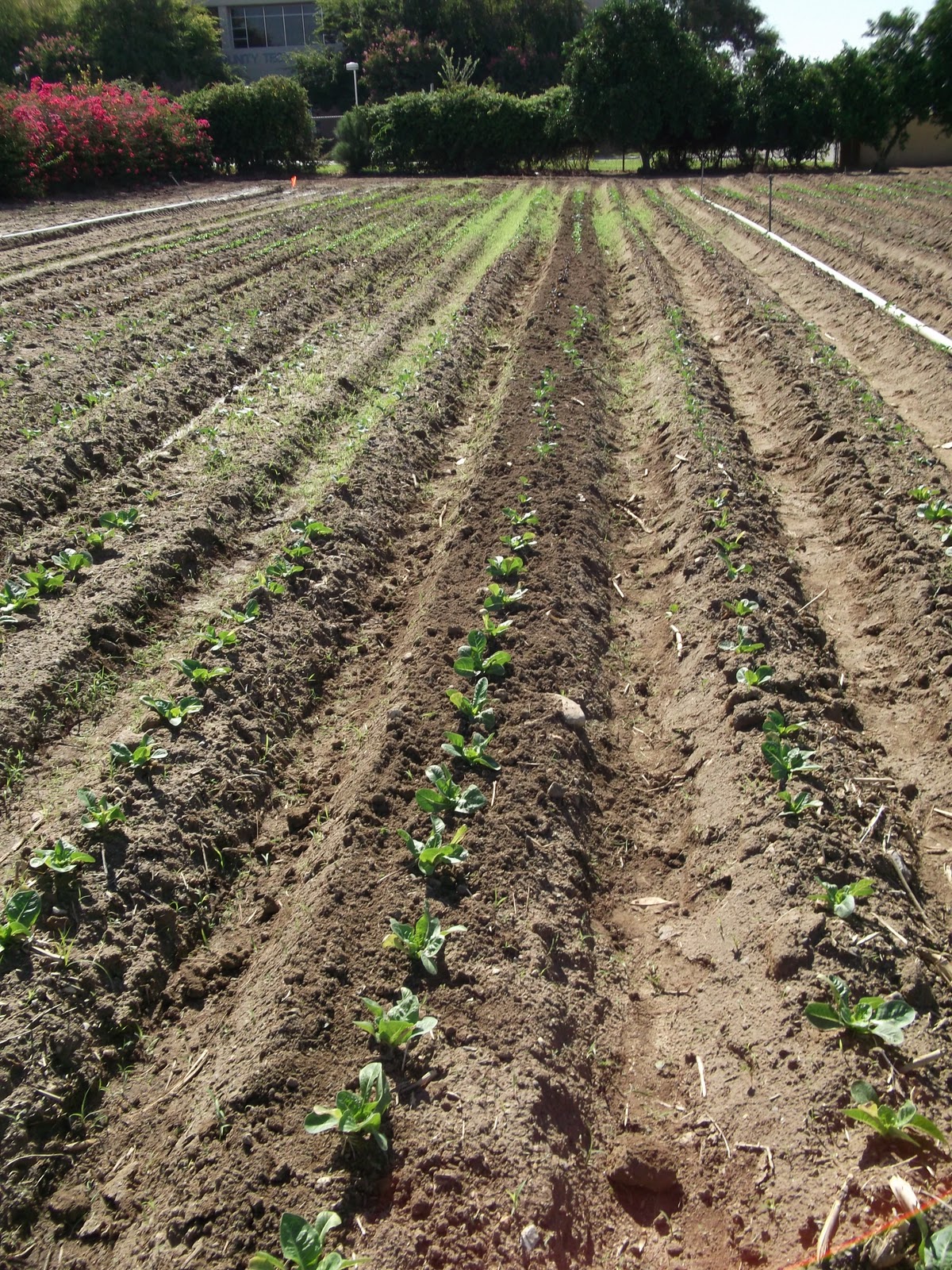
My row in the center of this picture was among a lucky few that were full of grass this week...  Thankfully, my wonderful Husband went along with me to school and helped me weed my bed, all 195' of it...


This marker denotes an area of my organic bed that I am experimenting on.  The plants behind the marker, up to the next marker were all treated with Superzyme, a biologic product full of beneficial organisms that are supposed to be fast acting and help your organic plants grow faster.  In my test plot (so far) my Superzyme treated plants are smaller than my untreated plants...  I will keep watching them and report again next week.


Another experiment, this time the product was called Actinovate and it left measurably larger plants.  Yippee! Sorry, these shots were taken before class and before the bed was cleaned up.


A successful IPM strategy includes frequently checking the plants in the field for pest and disease damage.  On the image above, you can see what is called "tunneling" inside the leaf.  This is done by leafminers, which are flying insect larvae that literally get inside the leaf and eat tissue, which makes them difficult to kill because they're inside.  Our organic field had a good amount of this damage, so far, it's not at threshold levels, but I suspect this is only going to get worse.  I wonder if the Professor will let us use Spinosad??? That's an organic insecticide that can "get them" with multiple applications; they have to ingest it from the plant tissue...


It may be hard to see in this picture (sorry, I get so excited when we catch a pest insect that my hands shake) but there is a small light green caterpillar on this leaf and he is the little villain responsible for all these holes.
He is a cabbage looper.  I caught my own shortly after I took this shot.  They are everywhere at the farm this week, turning our organic and some of our conventional cabbage plant leaves into swiss cheese.

All in all, it was a great day at the farm, we DID get the whole row weeded.  See.  The spots that look empty are actually red leaf lettuce.  When they're this small, they're almost invisible from this distance. lol


Later, to reward ourselves Jerry and I went to our local fair and enjoyed animals, tractors, crafts, fried foods, demonstrations, and lots of excitement.


I hope you had a great week too, and I hope next week is even better for you.  Bye for now!

I am linking this post up to my favorite HOPS!

&
Homestead Revival's Barn Hop
&